



Despite effective antiretroviral therapy, HIV continues to affect the human brain. A new study shows that damage to the central nervous system persists even when the virus is completely suppressed in the blood.
Researchers from Yale School of Medicine and the University Hospital of Lausanne, in an article in the Journal of Clinical Investigation, emphasize that the brain remains a kind of “reservoir” for HIV. Although active reproduction of the virus is controlled, genetic fragments of it — the so-called proviruses — persist in cells. These may remain defective, but are still able to produce viral RNA and proteins that support chronic inflammation. The authors analyze the accumulated results of studies to explain why, even with complete suppression of the virus in the blood, people living with HIV continue to have cognitive impairment and signs of brain damage.
This inflammation is not necessarily associated with active infection of brain cells. On the contrary, a significant role is played by the so-called “side effect” – when uninfected cells respond to signals from infected ones, which leads to damage to synapses and disruption of connections between neurons.
A separate role in this process is played by microglia – immune cells of the brain. Even with long-term treatment, they remain in a state of chronic activation. Moreover, studies show that these cells can undergo epigenetic changes that “reprogram” them for a long-term inflammatory response.
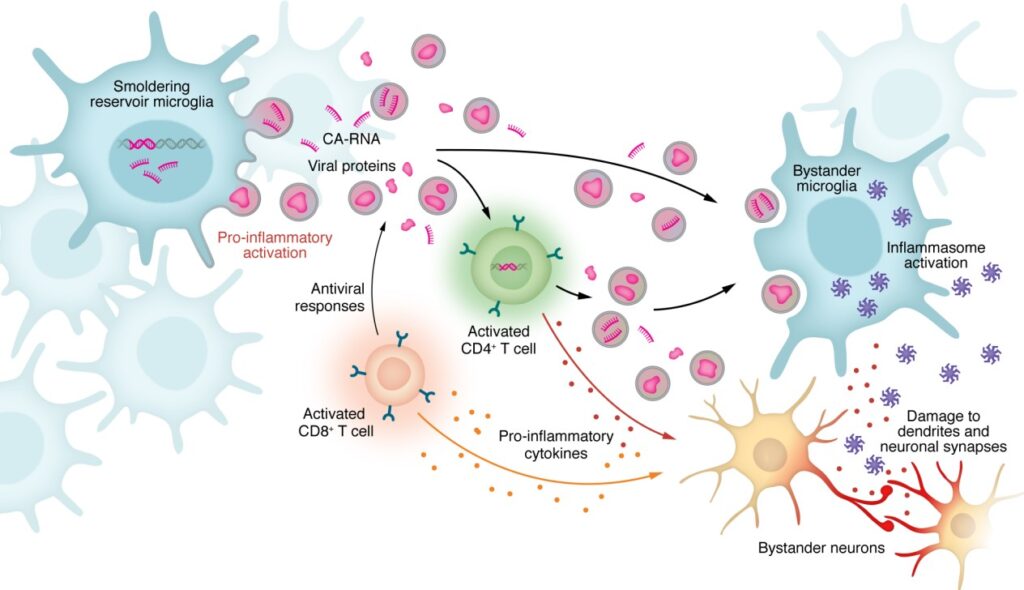
Despite a decrease in the frequency of severe lesions, up to 60% of people living with HIV may have various forms of cognitive impairment – from mild to more pronounced. At the same time, even in people without obvious symptoms, changes in brain structure, signs of inflammation and biochemical markers of damage to nervous tissue are detected.
The situation is complicated by the aging of people living with HIV. As life expectancy increases, the impact of concomitant factors increases – cardiovascular disease, metabolic disorders, psychoactive substance use, as well as polypharmacy. All of these factors additionally affect the state of the brain and can mask or exacerbate the effects of HIV.
The researchers also emphasize that traditional approaches to assessing cognitive impairment in HIV no longer fully correspond to modern reality. Instead, a new concept is proposed – “HIV-associated brain damage”, which is based not only on symptoms, but also on biological indicators, such as inflammation, neuroimaging and molecular markers.
Among the promising areas of research – the use of the latest technologies, in particular the analysis of individual cells, multiomics and the so-called “liquid biopsy” of cerebrospinal fluid. They allow for a more precise study of the processes occurring in the brain, without invasive interventions.
Another important area is the development of new approaches to treatment. Previous clinical trials of anti-inflammatory drugs have not yielded significant results, likely due to late intervention and insufficient consideration of biological mechanisms. Current research focuses on combination strategies that simultaneously target viral reservoirs, immune responses, and neural rewiring.
The researchers emphasize that even with effective treatment, HIV is not completely controlled in the brain. To overcome this challenge, new approaches are needed that combine a deep understanding of the biology of the disease with consideration of the social factors that influence health.
In conclusion, current data are changing the perception of HIV: it is not just an infection that can be controlled with medications, but also a complex chronic disease that continues to affect the body even in the absence of active viral replication.